
Last updated September 10, 2026
Full 25-point door and opener safety check with every visit - springs, cables, rollers, tracks, and your LiftMaster or Chamberlain opener included
You get a price before we start. It does not change when the truck arrives.
 Before
 After
After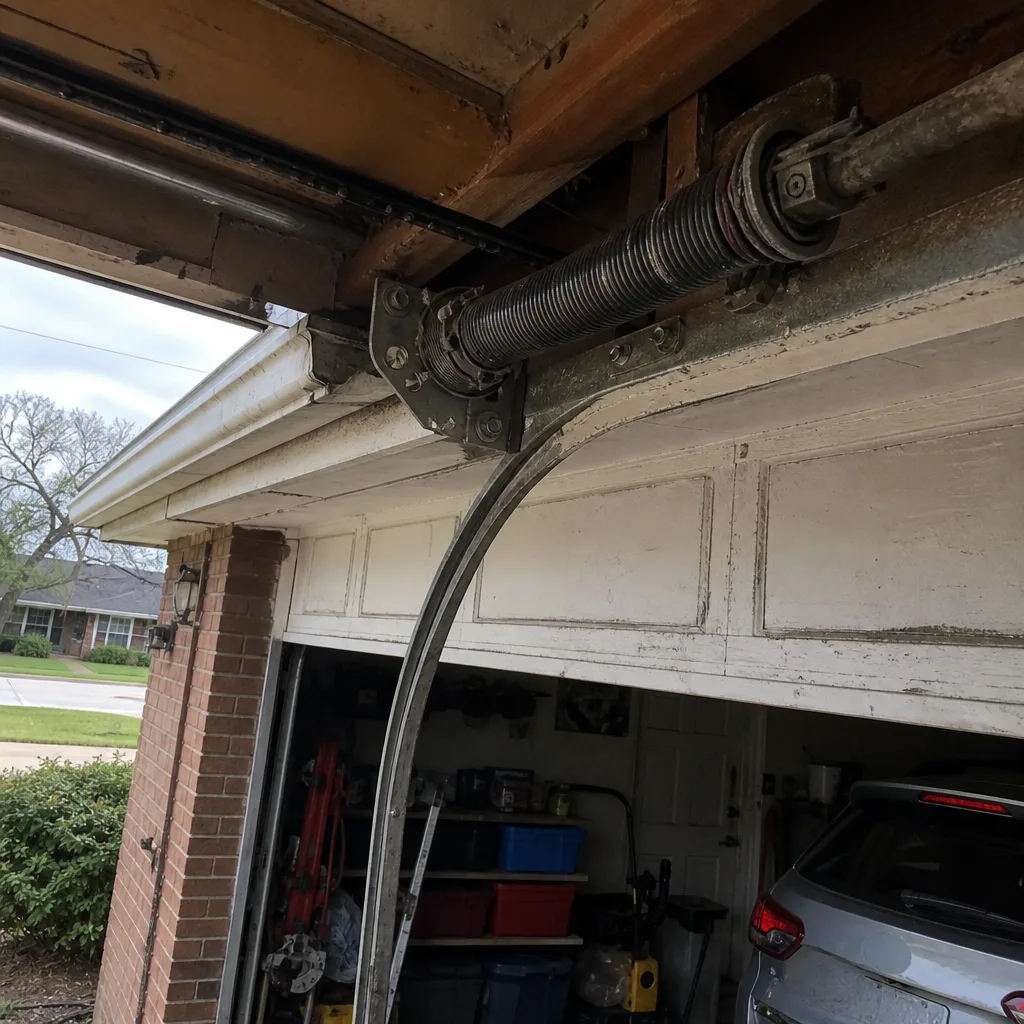 Before
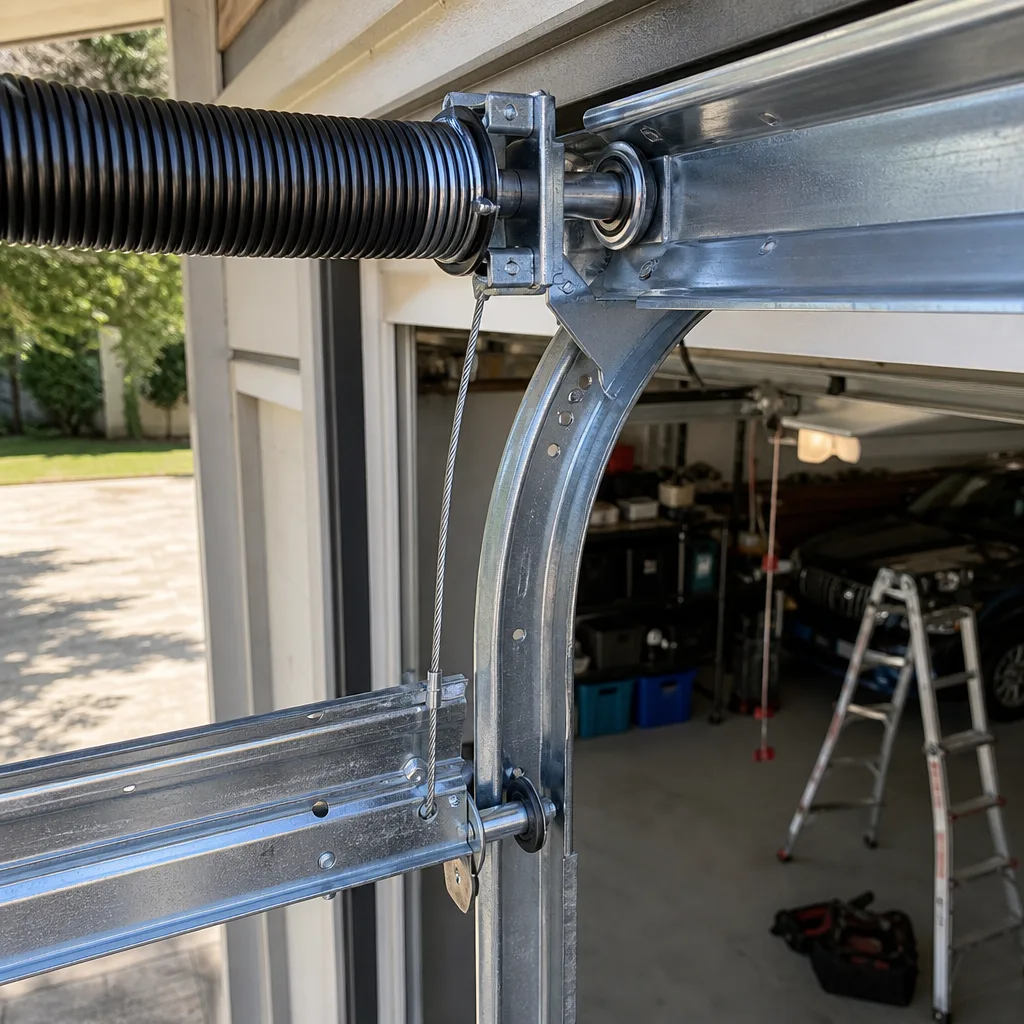 After
After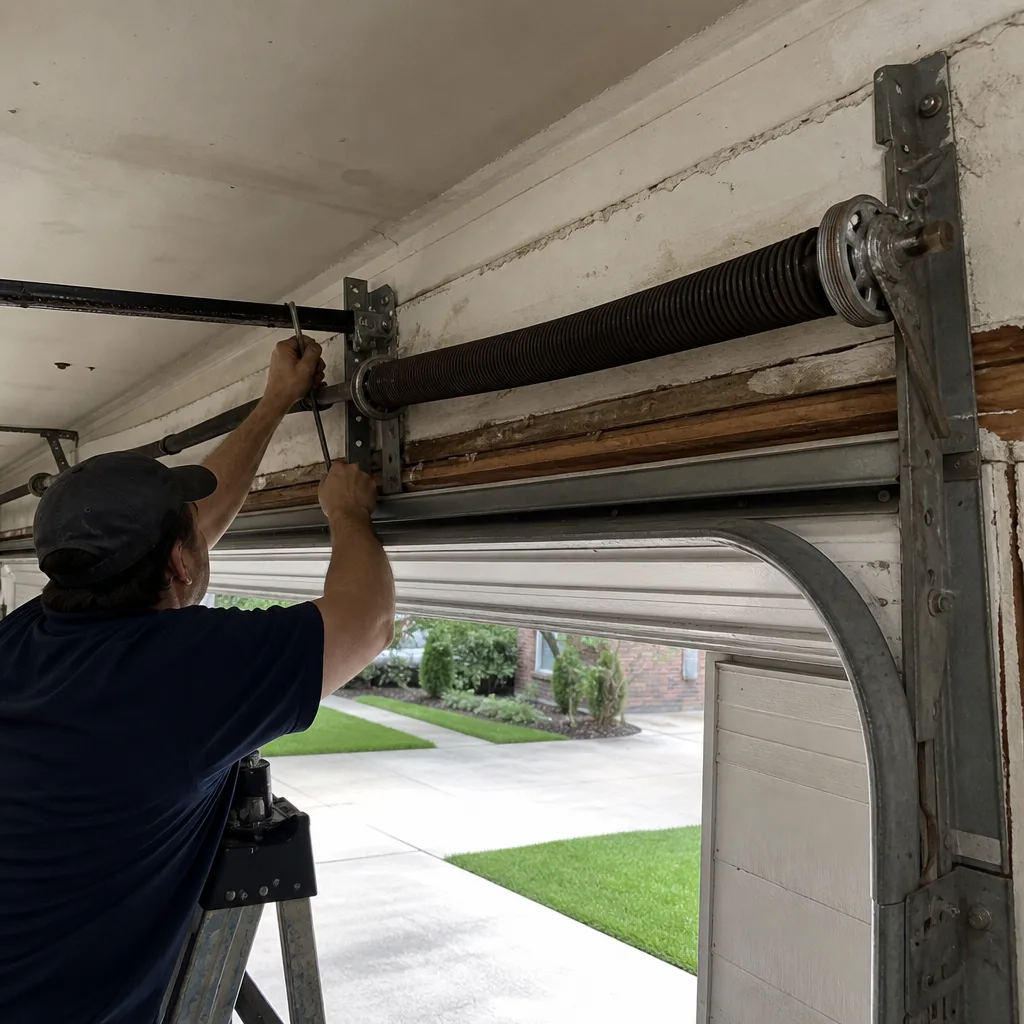 Before
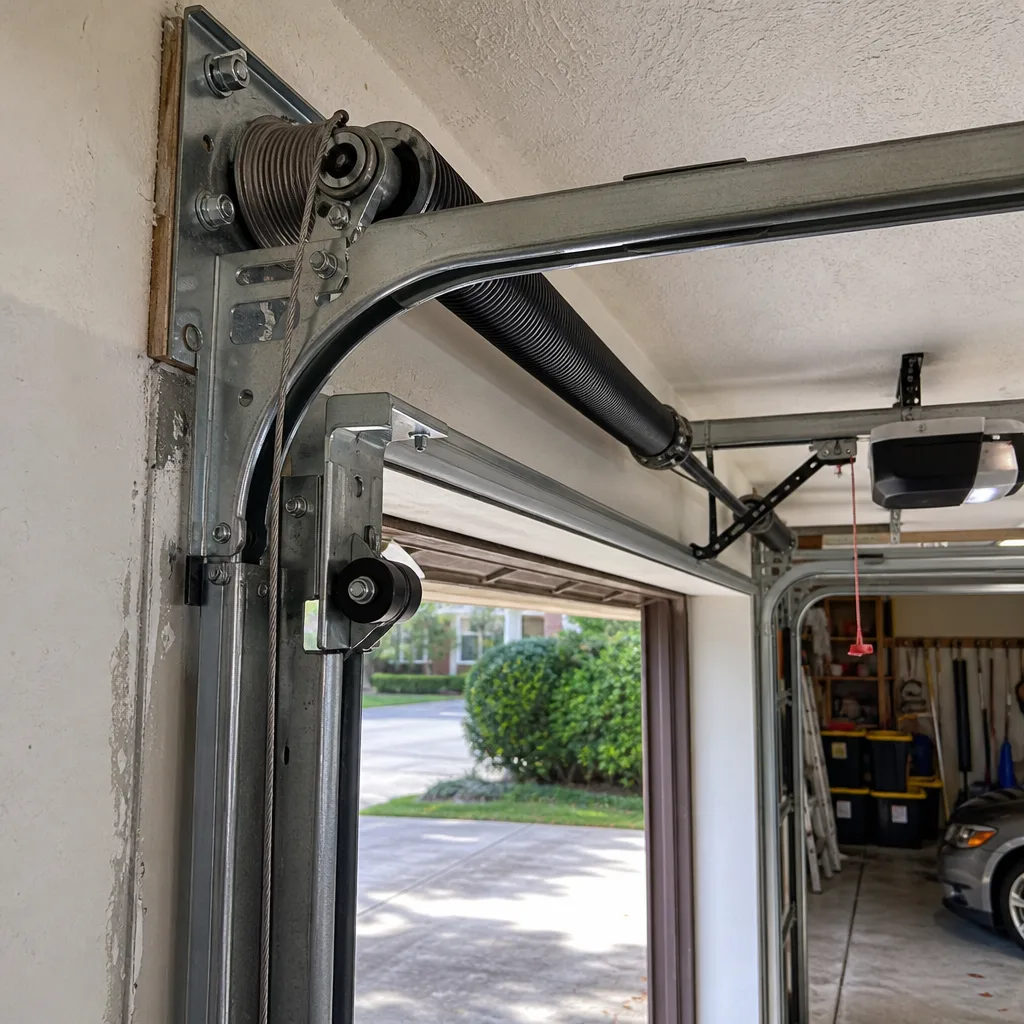 After
AfterSeasonal Garage Door Care for Bellaire: Year-Round Homeowner’s Guide
Bellaire’s garage doors don’t fail because of age alone. They fail because our Gulf Coast climate asks them to do four incompatible jobs in the same year: survive 100-degree thermal expansion in July, withstand sudden freeze contraction in January, resist wind load from tropical systems in August and September, and operate through two transition periods when metal, wood, and rubber all move at different rates. In our 42 years serving this market, we’ve found that the brief freeze events that hit Bellaire once or twice each winter do more cumulative damage to torsion springs than three full summers of heat cycling. The reason is simple physics: rapid temperature drop causes steel to contract faster than cast-iron cable drums compensate, creating micro-stress at the spring anchor points that adds up year after year. This guide is built around Bellaire’s actual climate calendar; for a deeper dive, see The Complete Guide to Garage Door in Bellaire, not the standard four-season template that works for Kansas or Ohio.
Quick Answer
Garage door care in Bellaire follows three distinct maintenance windows: a pre-hurricane inspection in early May, a post-freeze check within 24 hours of any ice event, and a comprehensive lubrication and adjustment during September and October when ambient temperatures allow materials to settle at their neutral state. Homeowners who document their door’s condition with phone photos at four reference points each season catch problems before they become emergency calls.
Table of Contents
- The Pre-Hurricane Checklist: What to Inspect Before Storm Season
- Summer Heat Protocol: Thermal Expansion and Hidden Gaps
- The Bellaire Freeze Event Response
- Fall Transition: The Season Most Homeowners Skip
- How to Document Condition Across Seasons
- What a Professional $89 Seasonal Tune-Up Covers
- Common Mistakes to Avoid
- When to Call a Professional
- Frequently Asked Questions
The Pre-Hurricane Checklist: What to Inspect Before Storm Season
Tropical storm and hurricane season runs June through November, but the smart money in Bellaire does the heavy inspection in early May. By then, the door has sat relatively undisturbed through the mild winter months, and any looseness that developed during fall’s thermal cycling is still present. Waiting until a named storm is in the Gulf means you’re competing with every other homeowner for technician availability.
Here’s what we check on every pre-season inspection, and what you can verify yourself with a flashlight and 20 minutes:
- Track bolt torque. The vertical tracks on either side of your door are held to the jamb framing with lag bolts or brackets. After years of vibration, these loosen. A loose track allows the roller to wobble, which transfers lateral load to the hinges during high wind. Grab each track near the top, middle, and bottom and attempt to move it side to side. Any play means the bolt needs tightening. Do not overtighten; stripped jamb wood is harder to fix than a loose bolt.
- Hinge pin condition. The hinges connecting your door sections carry the full weight of the door during opening and closing. Look for elongated holes, cracked steel, or pins that have worked their way upward. On older doors in Bellaire’s Braeburn Terrace and Broad Oaks areas, we see hinge failure more often than spring failure because the original hardware has simply cycled too many times.
- Weatherstripping adhesion. The rubber seal along the bottom of your door and the vinyl bulb seal on the stop molding are your primary defense against wind-driven rain. In May, run a garden hose at low pressure along the base of the closed door for 60 seconds. Any water intrusion means the seal has hardened, torn, or lost its compression set. Replace it before August.
- Opener force settings. Every automatic opener manufactured after 1993 has adjustable force and travel limits. If your door has become heavier due to spring fatigue, the opener compensates by applying more force. This masks the underlying problem and strains the opener’s motor and drive system. Test the safety reversal: place a 2×4 flat on the floor centered under the door. The door should reverse within two seconds of contact. If it doesn’t, the down-force is set too high.
- Backup power verification. If you have a battery backup opener, verify the battery holds charge. Bellaire’s grid is reliable until it isn’t, and a door that won’t open after a storm is a door you’ll need to lift manually, which may not be practical for every household member.
One detail specific to our market: homes near Bellaire’s western edge, closer to the Energy Corridor, often experience more rapid hardware corrosion due to slightly higher industrial particulate in the air. If you’re in that zone, inspect for surface rust on springs and cables even if the door is only a few years old.
The garage door repair in Bellaire page covers emergency wind damage response in more detail. For pre-season prevention, the goal is eliminating any condition that lets the door rack, bind, or leak under lateral pressure.
Summer Heat Protocol: Thermal Expansion and Hidden Gaps
July in Bellaire is not merely hot. It’s thermally aggressive in ways that affect garage doors specifically. Steel tracks expand roughly 0.0000065 inches per degree Fahrenheit per inch of length. A 9-foot vertical track heated from 75 degrees to 140 degrees in direct sun gains nearly 1/8 inch of length. That doesn’t sound like much until you realize the track is constrained at top and bottom, so the expansion manifests as bowing, binding, or fastener stress.
More consequential for homeowners is what happens to the door frame and header assembly. Wood expands and contracts across the grain at a different rate than steel. Vinyl and composite materials move differently still. By late July, gaps open between the garage door frame and the surrounding structure that were not visible in March. These gaps are entry paths for pests, humidity, and the occasional snake seeking cool concrete.
Here’s how to identify and address thermal expansion issues:
- Inspect at peak heat, not morning. Check your door at 3 PM on a sunny day, when materials are at maximum expansion. Look along the left and right jambs for daylight visible between the stop molding and the door edge. A consistent 1/8-inch gap is normal; anything larger suggests the door is out of plumb or the weatherstripping has compressed permanently.
- Check the header seal. The top of your door should seat firmly against the header weatherstrip when closed. If you can slide a business card through, humid attic air is entering your garage space. In Bellaire, that means your air conditioning load increases and your opener’s electronics operate in higher ambient humidity.
- Listen for binding on opening. A door that opens smoothly at 8 AM but grinds or slows at 4 PM is experiencing thermal binding. The cure is track alignment adjustment, not lubrication. Adding lubricant to a thermally bound system just attracts grit.
- Verify opener thermal protection. Openers mounted on garage ceilings in uninsulated spaces can reach internal temperatures that trigger thermal cutout. If your opener stops mid-cycle on hot afternoons and resumes after 15 minutes, the motor is protecting itself. Improved ventilation or a relocated opener solves this; repeated thermal cycling without correction shortens motor life.
We see a pattern in Bellaire’s warmer neighborhoods, particularly south of Evergreen near the West Loop: doors with western exposure fail faster. The afternoon sun hits the door and frame when they’re already heat-soaked from morning. If your garage faces west, consider a light-colored door or reflective window film on any glass panels. The difference in surface temperature can be 25 degrees or more.
The garage door installation in Bellaire page discusses insulated and reflective door options for extreme exposure situations. For existing doors, the summer protocol is observation and documentation, not major intervention.
The Bellaire Freeze Event Response
Bellaire does not have a winter. It has freeze events, typically one to three nights each year when temperatures drop below 28 degrees for four to eight hours. These events are mechanically destructive because they happen suddenly, after months of warm operation, and because homeowners respond by doing exactly the wrong things.
Here’s the physics that matters: your torsion springs are calibrated to a specific wire size, coil diameter, and active coil count at approximately 70 degrees. When the temperature drops to 25 degrees, the steel’s modulus of elasticity increases slightly, meaning the spring becomes stiffer. The cast-iron cable drums and the aluminum or steel door sections contract at different rates. The result is a system that was balanced in October but is now out of balance, with the springs holding more tension relative to the door weight than designed.
The 24-hour response protocol:
- Do not force a frozen door. If the door is stuck to the floor with ice, do not use the opener. The opener will attempt to pull with 500+ pounds of force, and something will give, usually the top section or the opener rail. Use a hair dryer or warm water to melt the ice, or wait for natural thawing.
- Inspect before first cycle. Once the door is free, open it manually to the halfway position and release it. A properly balanced door should stay put or drift slowly. If it falls hard or shoots upward, the spring tension has shifted. Do not use the opener until this is corrected; the opener is not designed to manage an unbalanced load.
- Check bottom seal adhesion. Cold rubber becomes rigid and can tear away from the retainer when the door first moves. Look for gaps or tears. A compromised bottom seal in January means water intrusion during the next rain, and in Bellaire, the next rain is rarely more than a week away.
- Listen for new noises. A single loud pop during the first post-freeze cycle often indicates a spring that has lost active coils through fracture. The door may still operate, but with reduced spring assistance. This is a countdown to full failure. Document the noise and schedule inspection.
- Lubricate after return to ambient temperature. Do not lubricate while components are below 40 degrees; the lubricant will not penetrate and will attract moisture. Wait 48 hours after the freeze event, then apply a silicone-based spray to rollers, hinges, and bearings. Avoid WD-40 or heavy grease on tracks.
In our experience serving Bellaire since 2016, the freeze events of February 2021 and December 2022 generated more emergency spring calls in a two-week period than the entire preceding year. The doors that survived best were those that had been professionally balanced within the previous 12 months and had intact weatherstripping that kept ice from bonding the door to the floor.
One local note: Bellaire’s older homes, particularly in the original platted sections near Bellaire Boulevard and the 610 Loop, often have detached garages with less insulation and more direct wind exposure. These doors experience more severe temperature swings and benefit from more frequent inspection.
Fall Transition: The Season Most Homeowners Skip
September and October in Bellaire are the hidden gem of garage door maintenance. The ambient temperature hovers in the 70s and low 80s, which is the neutral zone where steel springs, aluminum drums, vinyl weatherstripping, and wood frames all sit at their design dimensions. Lubricants flow properly. Adjustments hold. A door balanced in October stays balanced through winter and into spring.
Yet this is the season most homeowners ignore. The summer heat has faded, the door seems to be working fine, and hurricane attention has shifted to other concerns. This is exactly when a professional tune-up delivers the highest return.
Our garage door opener in Bellaire service page details opener-specific checks, but the fall protocol for the full door system includes:
- Spring tension verification with a calibrated scale. We measure the actual weight the opener must lift and compare it to the manufacturer’s specification. A 16×7 steel door should weigh approximately 150-180 pounds; the springs should carry all but 8-12 pounds of that. If the scale shows 30+ pounds at the opener, the springs are fatigued and the opener is working overtime.
- Roller replacement assessment. Nylon rollers degrade in heat and become brittle. Steel rollers develop flat spots from impact. Fall is the ideal replacement window because the new rollers seat properly at neutral temperature.
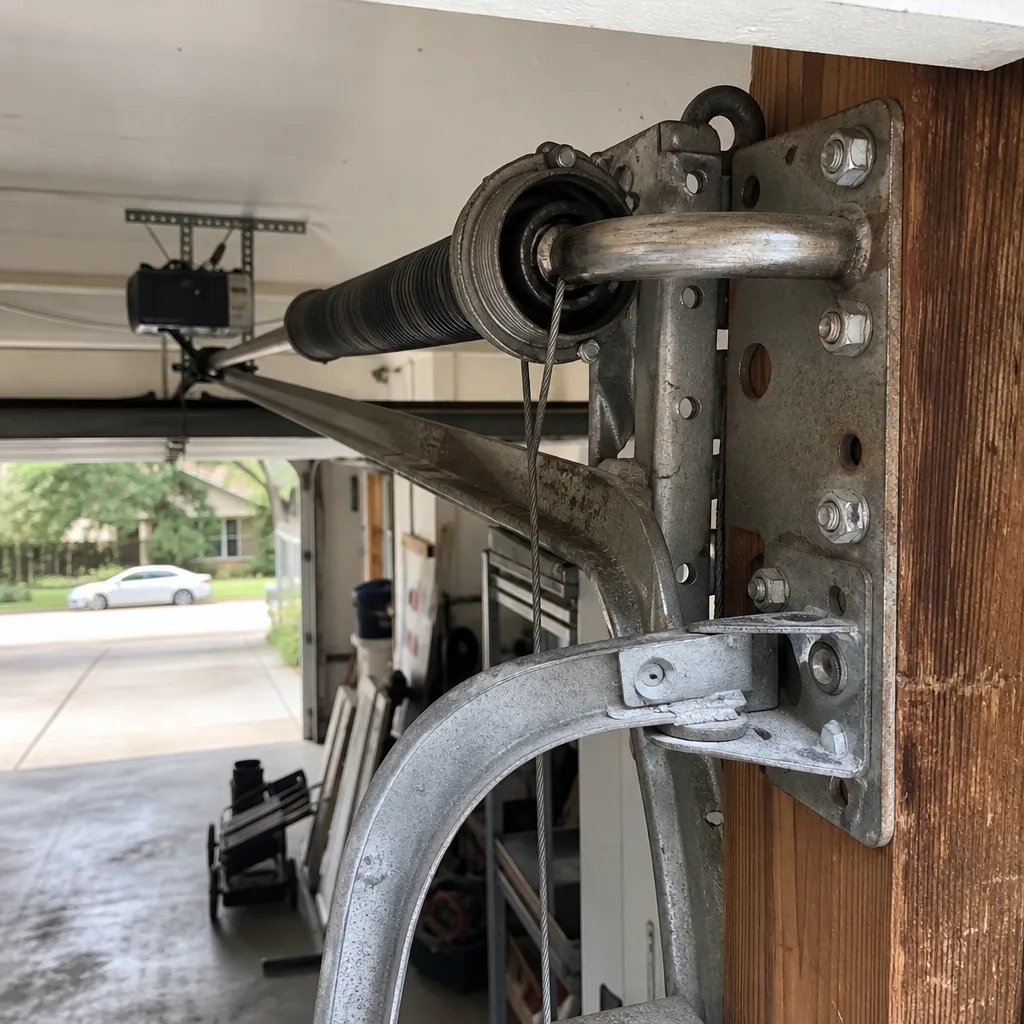
- Cable drum inspection for micro-cracking. The cast-iron drums at each end of the spring shaft develop stress cracks that are invisible to casual inspection. We check with a flashlight and magnifier. A cracked drum that separates under load drops the door suddenly and without warning.
- Track plumb and parallel verification. Using a level and measuring tape, we confirm the vertical tracks are plumb and the horizontal tracks maintain proper headroom clearance. Summer expansion often shifts these subtly.
- Weatherstripping replacement if compression set exceeds 30%. We measure the original profile against the current profile. Rubber that has permanently compressed to less than 70% of its original height no longer seals.
- Opener rail and chain/belt tension adjustment. Chain drives stretch; belt drives compress slightly. Both affect the opener’s ability to seat the door firmly against the floor without slamming.
The $89 Seasonal Tune-Up we offer every fall includes all of these checks, documented on a written report with photo documentation of any conditions requiring attention. For homeowners who’ve been in their house twenty years and plan to stay, this is the single most cost-effective service we provide. It prevents the emergency call at 6 PM on a Friday, the one that costs three times as much and arrives three hours late.
Carl Dutton has overseen this fall protocol since taking ownership, and our technicians are trained to treat every tune-up as if the homeowner will still be in that house in 2035, which many of our Bellaire customers will be.
How to Document Condition Across Seasons
The most sophisticated tool for garage door maintenance is already in your pocket. A phone photo, taken from the same four positions each season, creates a baseline that reveals change faster than any verbal description.
Here’s the method we teach our customers:
- Position 1: Full door, exterior, closed. Stand 10 feet back, centered. This shows panel condition, paint or finish degradation, and any visible sag or warp.
- Position 2: Left track assembly, interior. Focus on the upper curve where vertical meets horizontal. Capture the cable, drum, and top roller. Look for rust, fraying, or cable unwinding from the drum.
- Position 3: Right track assembly, interior. Same as left, for comparison. Asymmetry between left and right is often the first sign of spring imbalance.
- Position 4: Bottom section and floor seal, interior. Low angle, showing the gap between door bottom and concrete. Document light penetration, seal compression, and any concrete spalling or water staining.
Take these four photos in March, July, October, and January. Store them in a dedicated album. When you call for service, mention you have seasonal documentation. A technician who can compare current condition to prior state diagnoses faster and more accurately. In our shop, we flag these customers for priority scheduling because the call is almost always productive.
For Bellaire homeowners in flood-prone sections near Brays Bayou, add a fifth photo: the exterior grade around the garage entrance. Document whether water has ponded against the threshold during heavy rain. Chronic moisture exposure accelerates bottom section rust and concrete deterioration, both of which affect door alignment.
What a Professional $89 Seasonal Tune-Up Covers
We offer the $89 Seasonal Tune-Up as a standing service, available year-round, with fall being the optimal window. Here’s exactly what the technician does, in sequence, and what you receive:
| Step | Action | Standard or Additional |
|---|---|---|
| 1 | Visual inspection of all 12-16 hinges for cracks, elongation, or missing hardware | Standard |
| 2 | Roller condition assessment (nylon, steel, or ball-bearing) | Standard |
| 3 | Spring tension measurement with calibrated scale | Standard |
| 4 | Cable inspection for fraying, corrosion, or improper winding | Standard |
| 5 | Drum inspection for cracks or uneven wear | Standard |
| 6 | Track plumb, parallel, and fastener torque verification | Standard |
| 7 | Weatherstripping profile measurement and replacement recommendation | Standard |
| 8 | Opener force setting test and safety reversal verification | Standard |
| 9 | Photo eye alignment and obstruction test | Standard |
| 10 | Written condition report with photo documentation | Standard |
| 11 | Lubrication of rollers, hinges, bearings, and springs with silicone-based product | Standard |
| 12 | Any necessary adjustments to spring tension, track alignment, or opener limits | Standard |
| 13 | Replacement of worn rollers, cables, or weatherstripping | Additional (parts + labor) |
The tune-up takes 45-60 minutes. You receive the written report before the technician leaves. If any condition requires repair, the price is quoted and agreed before work proceeds. No surprises on the bill. The 90-Day Done Right Promise applies to any work performed.
For seniors and veterans, the permanent 5% discount applies to the tune-up and any same-visit repairs. We’ve had customers in Bellaire’s Southdale area who’ve scheduled this service every October for fifteen years. Their doors outlast neighborhood averages by a significant margin.
Common Mistakes to Avoid
- Using the opener as a diagnostic tool. If the door seems heavy, the opener strains, or it reverses unexpectedly, the instinct is to adjust the opener. This masks the real problem, which is almost always spring fatigue or track misalignment. The opener is the symptom reporter, not the disease.
- Lubricating the track. The track is not a bearing surface; the roller is. Lubricant on the track attracts dust and grit, creating an abrasive paste that accelerates roller and track wear. Lubricate rollers, hinges, and bearings. Wipe tracks clean and dry.
- Ignoring the first odd noise. A grinding, popping, or squealing noise is the door’s only vocabulary. In Bellaire’s humidity, a squeal that starts in March becomes a broken spring by August. The cost difference between adjustment and replacement is substantial.
- DIY spring adjustment. Torsion springs store enough energy to cause serious injury or death. The winding cones are under hundreds of pounds of torque. We do not provide instructions for this because no homeowner should attempt it. This is not gatekeeping; it is safety duty of care.
- Waiting for complete failure. A door that won’t open at 7 AM on a workday is an emergency. A door that opens slowly, noisily, or with visible panel flex is giving warning. Scheduled service costs less, happens at your convenience, and prevents the secondary damage that occurs when a failing component stresses everything connected to it.
- Using generic parts on brand-specific openers. LiftMaster, Chamberlain, Genie, and Raynor each have proprietary rail profiles, gear ratios, and safety systems. Universal replacement parts often compromise safety features or void remaining warranty. We carry factory-authorized components for all major brands.
- Neglecting the manual release. Every opener has a red cord for manual disengagement. Test it quarterly. If it won’t disengage, or if the door won’t stay open manually, you have a balance or spring problem that the opener has been hiding.
When to Call a Professional
Call when the door makes a noise it didn’t make last season. Call when it opens unevenly, with one side leading. Call after any freeze event if the balance test fails. Call before hurricane season if you found loose hardware during inspection. Call if the opener’s safety reversal fails the 2×4 test. Call if you cannot lift the door manually with one hand, or if it won’t stay at the halfway position.
Carl Dutton and the team at Mainspring Garage Door Co. home have served Bellaire since 2016, building on a company foundation laid in 1984. We answer the phone with a live person, 24/7, including nights, weekends, and holidays. Most repairs are completed in a single visit because our trucks carry springs, cables, openers, and hardware for all major brands. The price is stated before any work begins, and the 90-Day Done Right Promise covers every completed job in writing.
For a free estimate or to schedule your $89 Seasonal Tune-Up, call (832) 937-9424. We’ll be there when we say.
Frequently Asked Questions
Once per year is sufficient for most Bellaire homes, with fall being optimal due to neutral temperatures that allow accurate balance assessment. Homes with western exposure, detached garages, or doors cycled more than four times daily benefit from semi-annual inspection. Call (832) 937-9424 to schedule; estimates are free.
Homeowners can safely perform visual inspection, weatherstripping check, opener safety tests, and photo documentation. Any work involving spring tension, cable replacement, or track adjustment requires training and proper tools. Torsion springs are under lethal tension and should never be handled by anyone without specific training. For the tasks you can do, our $89 Seasonal Tune-Up handles the rest with professional calibration.
Thermal expansion is the cause. Steel tracks, aluminum door sections, and opener electronics all respond to temperature. In Bellaire’s July heat, a door that opens smoothly at 75 degrees may bind at 140 degrees surface temperature. The solution is track alignment adjustment, not more powerful opener settings. A technician can verify plumb and parallel with the door at operating temperature.
Do not use the opener. Melt the ice with warm water or a hair dryer, or wait for natural thawing. Once free, test manual balance before reconnecting the opener. Check the bottom seal for tears. If the door is unbalanced or makes unusual noises, schedule inspection before resuming normal use. Rapid temperature drops cause metal contraction that stresses springs; the 24 hours after a freeze event are when most winter failures occur.
Most common repairs in the Bellaire market range from $180 for roller and hinge replacement to $340 for spring or cable service. Opener repairs typically fall between $200 and $400 depending on component. Full door replacement starts around $1,200 for standard steel and increases with insulation, windows, or custom sizing. Mainspring states every price upfront before work begins, and the $50 Off Any Repair Over $250 standing offer applies automatically. Call (832) 937-9424 for an exact quote; estimates are free.
No. Our price is quoted and agreed before any work starts. If inspection reveals additional conditions, we explain them and quote separately. You approve every dollar before it is spent. This is the no-surprises approach we’ve used since 1984, and it’s why customers in Bellaire’s older neighborhoods call us back decade after decade.
The Bottom Line
Bellaire’s garage doors need a maintenance calendar that matches our actual climate: pre-hurricane inspection in May, thermal gap monitoring through July and August, post-freeze assessment within 24 hours of any ice event, and comprehensive professional service during September and October’s neutral temperatures. Document with four seasonal photos. Never force a frozen door. Never adjust springs yourself. Address the first odd noise before it becomes the last normal cycle. The homeowners who follow this protocol replace doors every twenty-five to thirty years instead of every twelve to fifteen, and they never make emergency calls at inconvenient hours. For a square deal from people who will still be in town when it matters, Mainspring Garage Door Co. has served this community since 1984. Explore more guides & resources on keeping your door reliable year-round.
Written by Carl Dutton, Owner at Mainspring Garage Door Co., serving Bellaire since 2016.